- Yes, let's give a stupid movie that will literaly have 15 minutes of fame more attention that it deserves
- Science is making Science Fiction boring
- Ah, rent seeking at its finest (pun intended, of course). So, is the problem here that businesses are lobbying those who will attain power or the power itself?
- This is why Obama was marginally appealing to me
- Man! If you can't rely on the "Republicans are in the pocket of Big Oil" shibboleth what can you rely on
Wednesday, August 13, 2008
Whatever

Wednesday, August 06, 2008
Whatever
- Obama wants to tax (i.e., reduce) the production of and subsidise (i.e., increase) the demand for oil. People, this is not hard: reducing the supply of or increasing the demand for a good, ceteris paribus, means the price will increase. Encouraging both as a plan to ease higher prices should be a sign of insanity (or political prowess).
- What's the big deal? We weren't using the Fourth Amendment anyway.
- Oooh! LHC is sexy (in a sciency sort of way)
- An interesting video explaining why, even if you are 100% innocent, you should never talk to the police (HT: Bruce Schneier)
- I agree with Perry's comment at the end of this blog post, but it won't be long before it is considered anti-social
- More significant than the iPhone?? How dare you say such things!
- The food industry, in an effort to avoid dealing with a problem itself, calls for more regulation. "More important than the financial loss is the loss of consumer confidence," says an industry representative. Well, getting consumers confident in your product is a cost you should have to bear. Calling for government to regulate makes you sound noble, but it has the added "benefit," I'm sure, of pushing out marginal competitors.
- Don't think that raising the minimum wage had no part is bringing this and this about
Wednesday, July 30, 2008
Whatever
- This is all we as libertarians ask. Instead we get this mess. And have I mentioned that markets work?
- Radley Balko asks some good questions of McCain and Obama
- A "political air show" (HT: The Agitator)
- Cue the conspiracy nuts. First we had the "Face on Mars" now the "Footprint on Titan."
- Sanity in Singapore
- Take a deep breath -- and thank Mt. Everest?
- We need more cow bell
Thursday, July 24, 2008
Big Government is Big Oil
I sent the following to the Raleigh News & Observer:
The original article that I am replying to is pretty sensationalist to begin with. It is obviously trying to stir up some controversy around how oil companies disperse their profits.
What is the proper distribution of revenue? Hell if I know. But if the oil companies are making the 'wrong' decisions then profits won't be a problem for them in the future, and idiot reporters won't have to worry about writing sensationalist claptrap.
Tuesday's front page story entitled “Big Oil spends to jack up stock” scrutinized international oil companies for business decisions made with their earned revenue. I was wondering if that same scrutiny will be used to examine the expenditures of those entities that control roughly 90% of the world's proven oil reserves. I am, of course, referring to governments around the world. I am not going to hold my breath, however, because we all know that expenditures on socialistic welfare programs are beyond scrutiny, while any form of profit is per se evil.Here are some examples of Big Government mismanagement of oil.
It is ironic that the term “Big Oil” is applied to entities that are puny in comparison to those that actually control oil. In reality Big Government is Big Oil.
The original article that I am replying to is pretty sensationalist to begin with. It is obviously trying to stir up some controversy around how oil companies disperse their profits.
What is the proper distribution of revenue? Hell if I know. But if the oil companies are making the 'wrong' decisions then profits won't be a problem for them in the future, and idiot reporters won't have to worry about writing sensationalist claptrap.
Wednesday, July 23, 2008
Whatever
- Just avoid smalltalk all together
- It's always fun to watch central banks blame their ineptitude on businesses
- How to stop a sequel
- Servitude is coming back into fashion. "I solemnly swear that I will never take part in any involuntary civilian service at the behest of the federal government, regardless of the consequences."
- Maybe this technology would be cost effective (i.e., profitable) if water prices were allowed to reflect reality
- A Nudge to fix the wrong problem
Wednesday, July 16, 2008
Whatever
- This is sarcasm, but the way monetary and fiscal policy in this country are run it could easily be reality
- I'm hungry for some watermelon. Could I borrow your umbrella?
- I can't wait to see the games that use these Wii attachments
- While Congress fumes about oil prices, those prices are trying to tell us something. Maybe what they are trying to tell us is that governments around the world are mismanaging oil production. Yes, I said governments. After all, 77% of proven oil reserves are controlled by a nationalized entity.
Wednesday, July 09, 2008
Whatever
- Check out the new use for the Segway (scroll down about halfway)
- Some good quotes from P.J. O'Rourke
- Ahh! So it ain't so!
- Reverse Graffiti
- And you thought a night at the opera seemed to last forever
- I knew playing Dig Dug would benefit humanity
- So, does this mean that if you vote for McCain you hate people?
- "The stimulus check was a way for some people to entertain themselves."
Sunday, July 06, 2008
Money and Power
Robert Frank, in a New York Times piece (free, annoying registration may be required), spews the typical liberal pabulum regarding campaign finance reform. I won't comment on the entire piece, but I want to say something about the general theme: money corrupting politics.
Just because our representatives are elected by a majority of the population and sit in the seats of power in Washington, doesn’t make them omniscient. It is silly to believe that just because they are not influenced by money that their decisions would be more just and wise. Sure, the policies would be different, but we are still dealing with mere mortals. They would have to be experts in economics, science, law, history, medicine, technology, etc. to govern as they do now. Only if we scale down the size of government dramatically will this arrangement even be remotely possible. But, at that point there would be no need for campaign finance legislation because government would not have the heavy hand it does now nor would it have anything to sell.
But why do we need to limit contributions anyway? If we are assuming that these people we send to Washington are wise enough to determine the ‘right’ legislation if they were only free from the corrupting influence of money, why are they not wise enough now to just not be corrupted by the money in the first place? In other words, if they are so easily corrupted now, maybe they aren't fit govern at any time.
It could be said that we would want politicians to only get influence from the experts in the respective fields. But who are the experts? Do all experts agree? Who will be the arbiter if they don’t? Again, with a small government limited to a specific set of tasks, this could possibly work (I still have my doubts, however).
The other question we need to ask is how is it possible to prevent conflicts of interest? We are a nation of 300 million and we have different interests and wants. If government is reduced to a fraction of its current size this might be possible, but when government spends $3 trillion and has its tentacles in every aspect of our lives there are going to be conflicts of interest when it comes to how to spend that money and wield that power.
Lastly, I would like to comment on a specific quote in the article. After begrudgingly admitting that money can't be completely eliminated from the political process, Frank writes this: "The harsh reality is that free speech and good government are conflicting goals." When I first read that statement I had to stop and say "Wow!" Free speech is now a "goal" - not an inalienable right of the individual, mind you - a goal that can be negotiated like all other issues in government. Maybe this is why so many people want to buy influence. Maybe this is why so many people need to buy influence.
Let me use Mr. Frank's language to close: free speech and big government are conflicting goals. In fact, any individual right and big government are conflicting goals.
Just because our representatives are elected by a majority of the population and sit in the seats of power in Washington, doesn’t make them omniscient. It is silly to believe that just because they are not influenced by money that their decisions would be more just and wise. Sure, the policies would be different, but we are still dealing with mere mortals. They would have to be experts in economics, science, law, history, medicine, technology, etc. to govern as they do now. Only if we scale down the size of government dramatically will this arrangement even be remotely possible. But, at that point there would be no need for campaign finance legislation because government would not have the heavy hand it does now nor would it have anything to sell.
But why do we need to limit contributions anyway? If we are assuming that these people we send to Washington are wise enough to determine the ‘right’ legislation if they were only free from the corrupting influence of money, why are they not wise enough now to just not be corrupted by the money in the first place? In other words, if they are so easily corrupted now, maybe they aren't fit govern at any time.
It could be said that we would want politicians to only get influence from the experts in the respective fields. But who are the experts? Do all experts agree? Who will be the arbiter if they don’t? Again, with a small government limited to a specific set of tasks, this could possibly work (I still have my doubts, however).
The other question we need to ask is how is it possible to prevent conflicts of interest? We are a nation of 300 million and we have different interests and wants. If government is reduced to a fraction of its current size this might be possible, but when government spends $3 trillion and has its tentacles in every aspect of our lives there are going to be conflicts of interest when it comes to how to spend that money and wield that power.
Lastly, I would like to comment on a specific quote in the article. After begrudgingly admitting that money can't be completely eliminated from the political process, Frank writes this: "The harsh reality is that free speech and good government are conflicting goals." When I first read that statement I had to stop and say "Wow!" Free speech is now a "goal" - not an inalienable right of the individual, mind you - a goal that can be negotiated like all other issues in government. Maybe this is why so many people want to buy influence. Maybe this is why so many people need to buy influence.
Let me use Mr. Frank's language to close: free speech and big government are conflicting goals. In fact, any individual right and big government are conflicting goals.
Solutions?
Thomas Sowell once said that "there are no solutions...there only trade-offs." We are learning that lesson good and hard today.
Friday, July 04, 2008
Little Brother
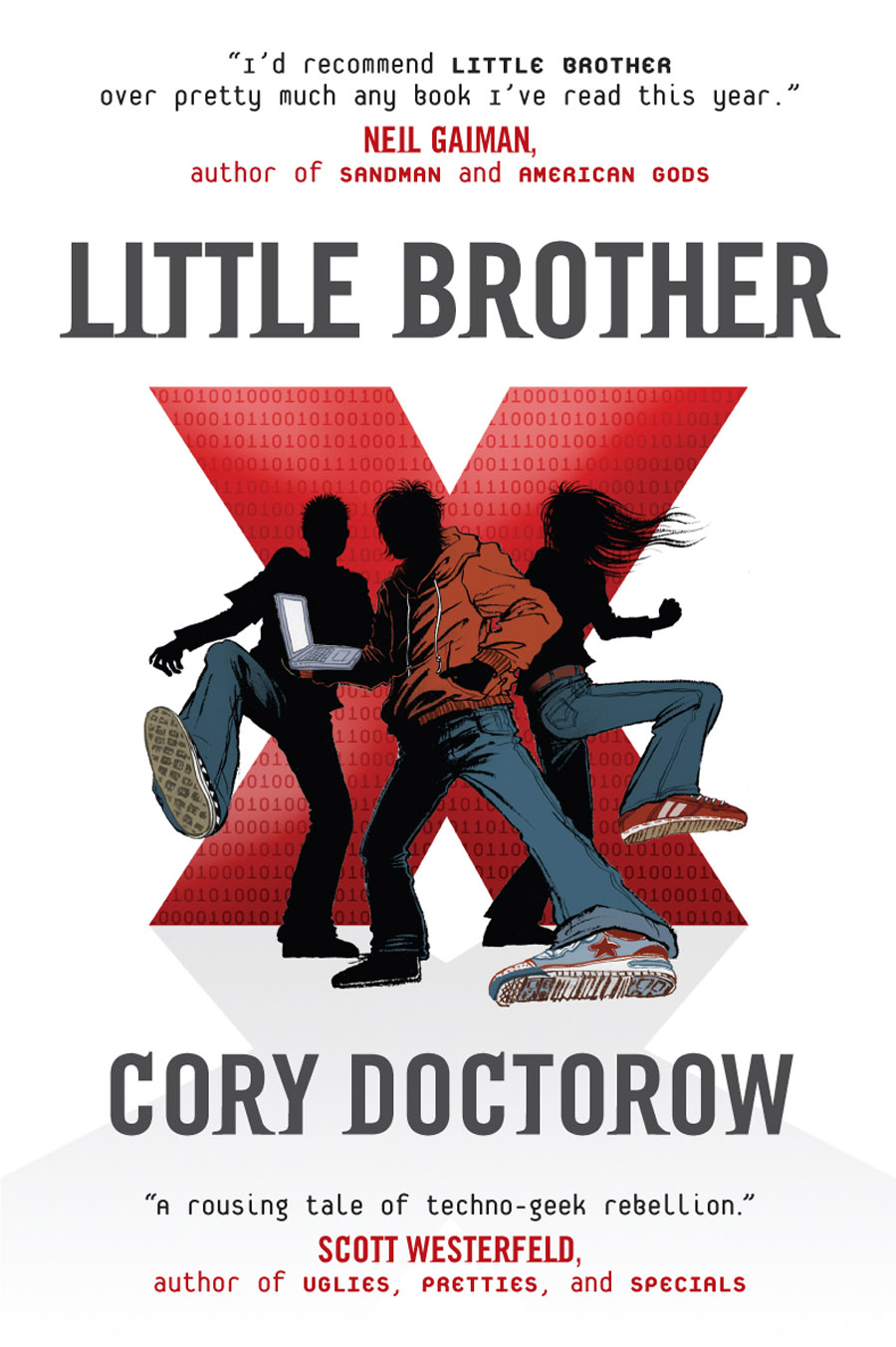
I just finished reading Cory Doctorow's Little Brother. I highly recommend it to those who like stories about technology and using technology in a clandestine manner. It reminded me a lot of a book I read a long time ago by Clifford Stoll called The Cuckoo's Egg. The books have different plots (in Stoll's book the hacker is the bad guy), but in both you get a small glimpse into the hacker culture.
Even if you don't like stories about technology, however, you should read Little Brother. It's an inspiring tale about a young man not willing to let the government get away with tyranny even if it means his own freedom.
One interesting aspect in my experience reading this book was following along with Google Maps Street View. I was able to follow the action in the streets of San Francisco (a city that I've been to twice but really didn't get to see). Try it, it's fun.
Obama on Iraq...for now
I guess I should have seen this coming. Oh wait, I did. So, for those of you who were worried that I might vote for Obama (if I was really, really forced to), don't worry.
Wednesday, July 02, 2008
Whatever
- All new technologies should have a Star Wars demo
- If this is a joke it sure the hell ain't funny (HT: Dispatches)
- Some sanity on 'cap-and-trade' schemes
- #51. They don't sit around reading lists about how to be successful
- Obama panders and panders and panders
- What can onions teach us about oil prices?
Wednesday, June 25, 2008
Whatever
- I love this idea of "competing" tax plans. It's like competition between McDonald's and Burger King - the differences are marginal and they both suck.
- Oooh, save me from Google, I'm so oppressed
- Jason Kuznicki does a great job at debunking the idea that the recent Supreme Court decision regarding Habeas rights will lead to a "flood" of lawsuits. And here is some good stuff from George Will, as well.
- The Web Time Forgot (annoying, free registration may be required - try BugMeNot)
- Is labeling menus with nutritional content a good idea? Maybe not.
Monday, June 23, 2008
Oh Obama!
I know I've blogged in the past that if forced to I would vote for Obama. But now it is becoming harder for me to even make that concession.
Obama has given his support to a bill that will, in Glenn Greenwald's words, legalize "many of the warrantless eavesdropping activities George Bush secretly and illegally ordered in 2001." Here is the way he justifies his decision:
Secondly, I thought I had a Constitution to protect my liberties, not your work ethic.
My very limited support for Obama was largely based on his rhetoric that he would get us out of Iraq. Now I'm thinking that if he is elected President we will get a statement from him next January which begins thusly,
Obama has given his support to a bill that will, in Glenn Greenwald's words, legalize "many of the warrantless eavesdropping activities George Bush secretly and illegally ordered in 2001." Here is the way he justifies his decision:
Given the grave threats that we face, our national security agencies must have the capability to gather intelligence and track down terrorists before they strike, while respecting the rule of law and the privacy and civil liberties of the American people. . . .First of all, what if you are not elected President? You just supported a bill that you basically admit has problems that could affect the liberty of the American people. How will you feel in January if John McCain gets that power? You shouldn't support legislation that has as a contingency the need for the "right" people enforcing said legislation.
After months of negotiation, the House today passed a compromise that, while far from perfect, is a marked improvement over last year's Protect America Act. . . It does, however, grant retroactive immunity, and I will work in the Senate to remove this provision so that we can seek full accountability for past offenses.
It is not all that I would want. But given the legitimate threats we face, providing effective intelligence collection tools with appropriate safeguards is too important to delay. So I support the compromise, but do so with a firm pledge that as President, I will carefully monitor the program, review the report by the Inspectors General, and work with the Congress to take any additional steps I deem necessary to protect the lives -– and the liberty –- of the American people.
Secondly, I thought I had a Constitution to protect my liberties, not your work ethic.
My very limited support for Obama was largely based on his rhetoric that he would get us out of Iraq. Now I'm thinking that if he is elected President we will get a statement from him next January which begins thusly,
Given the grave threats that we face, our military must continue to be deployed ... blah blah blah.Whatever!
Wednesday, June 18, 2008
Whatever
- Carbon Nanotubes seem to be the duct tape of science
- Now this is my kind of town
- Oil 2.0
- Time to break out the aerosol cans again
- Oh how cute. Cuba is joining the Twentieth Century.
- Yeah, you know you're curious
- This is just unfortunate
- I should keep my witty comments to myself on this one because my wife reads this blog (but I'd love one of these)
Tuesday, June 17, 2008
No Win
We are now going to have the courts flooded with so-called...habeas corpus suits against the government, whether it be about the diet, whether it be about the reading material. And we are going to be bollixed up in a way that is terribly unfortunate because we need to go ahead and adjudicate these cases."Those were the words of John McCain in response to the recent Supreme Court ruling on Guantanamo Bay detainees. It is also a big reason why I can't vote for him this year.
Habeas Corpus is not about filing suits to complain about diet or reading material; the term literally means 'you have the body'. It is a basic right, not of Americans, but of all human beings to challenge their imprisonment in front of a neutral party. For McCain, a Senator and Presidential candidate, to make such a silly statement is disturbing.
I shouldn't be surprised, though. I've always disliked McCain because of his stance on civil liberties. His support for
Oh, BTW, here is one of many reasons why I can't vote for Obama this year either. Surprise, surprise, he'll raise taxes.
Monday, June 16, 2008
Little Pink Houses
People of Cary unite! Rise up against those who would allow home values to not soar ever so skyward! Down with the powers who do nothing to free us from the pain we suffer when prospective buyers avert their eyes!
The Colorist class, with their disdain for the historical progress of drab, must no longer be allowed to offend the Beige class. Talk of 'rights' is a polycolorist tactic which should be looked upon with a blank stare, and disregarded as if not even mentioned.
Polycolorism, after all, is just a superstructure foisted upon society at the behest of the Colorists with the full complicity of their pawns in power. We must break the chains that bind us to this superstructure so that history can pass into the Age of Drabness.
Rise up! Or succumb to the Rainbow.
The Colorist class, with their disdain for the historical progress of drab, must no longer be allowed to offend the Beige class. Talk of 'rights' is a polycolorist tactic which should be looked upon with a blank stare, and disregarded as if not even mentioned.
Polycolorism, after all, is just a superstructure foisted upon society at the behest of the Colorists with the full complicity of their pawns in power. We must break the chains that bind us to this superstructure so that history can pass into the Age of Drabness.
Rise up! Or succumb to the Rainbow.
Wednesday, June 11, 2008
Whatever
- Surprise yourself!
- Markets adapt, government exacerbates (HT: EconLog). More of the same.
- i cn se whi she hat a sezur
- Gee, raising the minimum wage is hurting unskilled workers. Who'd thought that?
- Minesweeper, The Movie
- Man-made Global Shaking?
- Goosh!
Wednesday, June 04, 2008
Whatever
- Another reason why Wal-Mart is one of the greatest anti-poverty forces in history
- Neat stuff for space geeks (like me)
- This is utterly disgusting. Check out the sign - "Find out when you should die." (HT: Coyote Blog)
- I beg your pardon?
- The 100 Greatest Guitar Songs of All Time (Purple Rain!?! in the top 20)
- Can you really love your country? "Insisting on the alleged virtue of loving one’s country mainly serves to give those in power a blank check."
Monday, June 02, 2008
The Religion of Politics
[I recently finished Bryan Caplan's The Myth of the Rational Voter. In this and future posts I will provide my chapter-by-chapter notes.]
Beyond the Miracle of Aggregation
He asks the question: Are voter errors systematic on questions of direct political relevance? He answers yes, and lays out a set of biases that voters seem to hold. These are
Caplan then goes on to talk about how politics is a form of religion: "Political/economic ideology is the religion of modernity." People find comfort in politics as they do with religion, and some of the same passions are exhibited as well. He gives the comparison of the Inquisition of the Middle Ages and totalitarian regimes of the 20th Century. I've often made the comparison between socialism and religion. Caplan, however, does not make this comparison himself - it's nationalism and social revolutions that he is concerned with.
Keeping with the theme of religion, Caplan shows how voters can afford to be ideological. In a democracy voters do not pay the "full price" for their beliefs because the odds of one vote having a substantial influence on policy diminishes with the growing voter base. "The price of ideological loyalty is close to zero," so people can easily partake in ideological delusions. "Faith is a shortcut to belief."
In a democracy, "negative externalities irrelevant to individual behavior add up to a large collective misfortune." People will rationalize their errors, however, going so far as to deify those who encourage their delusions; victimizing those who destroy those delusions.
All this means is that in the end democracies fall short because voters get the foolish policies they ask for.
Beyond the Miracle of Aggregation
Voter ignorance is a product of natural human selfishness, not a transient cultural aberration.Caplan explains the Aggregation concept which says that individual voter ignorance is canceled out over the large population of voters. His main thesis, however, shows that this only applies if there isn't systematic ignorance throughout the population (or the voters don't make systematic errors).
- Bryan Caplan
He asks the question: Are voter errors systematic on questions of direct political relevance? He answers yes, and lays out a set of biases that voters seem to hold. These are
- Antimarket bias
- Antiforeign bias
- Make-work bias
- Pessimistic bias
Caplan then goes on to talk about how politics is a form of religion: "Political/economic ideology is the religion of modernity." People find comfort in politics as they do with religion, and some of the same passions are exhibited as well. He gives the comparison of the Inquisition of the Middle Ages and totalitarian regimes of the 20th Century. I've often made the comparison between socialism and religion. Caplan, however, does not make this comparison himself - it's nationalism and social revolutions that he is concerned with.
Keeping with the theme of religion, Caplan shows how voters can afford to be ideological. In a democracy voters do not pay the "full price" for their beliefs because the odds of one vote having a substantial influence on policy diminishes with the growing voter base. "The price of ideological loyalty is close to zero," so people can easily partake in ideological delusions. "Faith is a shortcut to belief."
In a democracy, "negative externalities irrelevant to individual behavior add up to a large collective misfortune." People will rationalize their errors, however, going so far as to deify those who encourage their delusions; victimizing those who destroy those delusions.
All this means is that in the end democracies fall short because voters get the foolish policies they ask for.
Wednesday, May 28, 2008
Whatever
- An interesting way to use a courier service
- Three small dots were never so impressive
- And I thought those people with Bluetooth phone headsets were annoying!
- Another reason why voting this year will be pointless. Neither candidate understands the the concept of individual liberty.
Wednesday, May 21, 2008
The Price of Eyeballs
On a recent episode of EconTalk, Russ Roberts interviewed Chris Anderson who was claiming "many delightful things in the world are increasingly free." This is supposed to be some new economics that businesses need to conform to or die. I'm skeptical.
The economics behind this phenomena is actually interesting, and Fernando Herrera-Gonzalez over at the Mises Institute I think explains it incredibly well. The following is where it clicked for me:
Now Microsoft is actually making this even more blatant. They plan on paying cash to users who purchase goods found using their Live Search engine.
The interesting thing is that is this is not new. Broadcast television has operated on this model for over fifty years - they pay for your eyeballs with entertainment so that they can attract their true customers.
The economics behind this phenomena is actually interesting, and Fernando Herrera-Gonzalez over at the Mises Institute I think explains it incredibly well. The following is where it clicked for me:
Google offers us free use of their search engine and other web applications. Why? Because that is how Google attracts our attention to its advertisements. Google doesn't sell its online services to us; it sells an audience to its actual costumers, the advertisers. Google is buying our time and selling it wholesale. As time is a scarce resource, and time (and attention) demand is increasing as a result of fierce competition on the Internet, Google has to pay us ever more, according to the law of diminishing returns. This payment is made not in terms of money, but as storage and process capacity. That's why Google keeps increasing its "free" offering to us, its providers, in terms of, e.g., storage capacity for e-mail accounts.You see, we are not Google's customers. Google pays us for our eyeballs with free disk space and applications so that they can attract their true customers - advertisers.
Now Microsoft is actually making this even more blatant. They plan on paying cash to users who purchase goods found using their Live Search engine.
The interesting thing is that is this is not new. Broadcast television has operated on this model for over fifty years - they pay for your eyeballs with entertainment so that they can attract their true customers.
Friday, May 16, 2008
Wednesday, May 14, 2008
Whatever
- Hmmm...and they wonder why businesses must pay extortion money to politicians
- Ok, but what if you are both?
- When I saw this I nearly ruined my keyboard with drool
- Ok, maybe this is a little too much Star Wars for one post...nah! There can never be too much Star Wars!
- The corrupting influence of rock and roll
- You can bury me in the R2-D2 DVD player
- Don't ever try to do something nice for a stranger. It may be illegal. (HT: Coyote Blog)
- Stupid people shouldn't be activists (HT: Dispatches from the Culture Wars)
- This says it all (HT: Carpe Diem)


Tuesday, May 06, 2008
Oh Hillary!
So I see that Hillary Clinton doesn't care too much for economists:
Thanks to Arnold Kling at EconLog for the link. Also, his cohort Bryan Caplan has this intriguing view on why Hillary would be harmless as president. In summary, she wouldn't get much done because people hate her so much. Hillary, Divisiveness we can believe in!
"I'm not going to put my lot in with economists," Clinton said when asked to name an economist who backed her proposal.I'm confused. Is she part of the "faith-based" or "reality-based" community?
"We've got to get out of this mind-set where somehow elite opinion is always on the side of doing things that really disadvantage the vast majority of Americans."
Thanks to Arnold Kling at EconLog for the link. Also, his cohort Bryan Caplan has this intriguing view on why Hillary would be harmless as president. In summary, she wouldn't get much done because people hate her so much. Hillary, Divisiveness we can believe in!
Tuesday, April 22, 2008
Who is John Alpha?
If you like science fiction and/or suspense thrillers, I highly recommend the 7th Son Trilogy by J.C. Hutchins. I just finished listening to the last book and I find myself wishing for more. It has clones, blood, computers, government conspiracies, blood, international mayhem, blood, oil, and more. Oh, and blood!
Do yourself a favor and go to iTunes now and download Book One to your iPod (or use whatever feeble mp3 player you find yourself having to cope with).
Do yourself a favor and go to iTunes now and download Book One to your iPod (or use whatever feeble mp3 player you find yourself having to cope with).
Saturday, April 05, 2008
Whatever
- Paying taxes is patriotic? Boy, have we come a long way!
- Yeah, I know I said that if I had to vote then I would probably vote for Obama, but his pandering and economic ignorance is really why I can't vote for him (HT: Q&O)
- "You've never heard of the Millennium Falcon?"
- An Obama-gasm
- If you can't laugh at Manifest Destiny what can you laugh at?
- The Twenty-First Century's Nineteenth Century problem
- More socialized health care problems in the UK. And one of our own.
Sunday, March 30, 2008
Solutions that aren't
Why do I not look to government to solve environmental problems? Two recent news items should help explain.
First, Time Magazine is reporting on the disaster that is ethanol.
The second item appeared today in the Raleigh News & Observer and deals with the disposal of Compact Fluorescent (CF) light bulbs (those new bulbs that you will be forced to purchase in a few years).
Whatever!
First, Time Magazine is reporting on the disaster that is ethanol.
Even cellulosic ethanol made from switchgrass, which has been promoted by eco-activists and eco-investors as well as by President Bush as the fuel of the future, looks less green than oil-derived gasoline.What has been a dirty little secret for years is finally becoming common knowledge. Yet, we still subsidize and encourage ethanol production.
...
[T]he basic problem with most biofuels is amazingly simple, given that researchers have ignored it until now: using land to grow fuel leads to the destruction of forests, wetlands and grasslands that store enormous amounts of carbon.
The second item appeared today in the Raleigh News & Observer and deals with the disposal of Compact Fluorescent (CF) light bulbs (those new bulbs that you will be forced to purchase in a few years).
Disposal options: Don't throw fluorescents in the trash. The light will break and release mercury. In a landfill, it could contaminate the ground. If you must throw a burned-out CFL into the trash, seal it first in two plastic bags to prevent leakage.So let me get this straight, I'm not supposed to dispose of the bulbs in the usual way because I will be contaminating the environment with mercury. Instead, I should drive to a central recycling facility to dispose of these bulbs, thereby contaminating the environment with carbon dioxide from my car.
The preferred method is to take CFLs to a recycling facility or hazardous waste facility.
Whatever!
Monday, March 24, 2008
Sunday, March 23, 2008
Whatever
- Ha! Unintended my behind!
- It's Easter, so it must be time for Peeps
- Holding the sun
- Looks like a dog, sounds like a big ass bee
- What did you do at work today?
Thursday, March 20, 2008
More on Obama
I listened to Barack Obama's recent speech on race and was impressed - it was philosophical and nuanced. As much as I don't like politicians I do like listening to people who have a gift for speech and who speak with depth on serious issues.
I'm not going to say much more about it because I think Jason Kuznicki at Positive Liberty nails it. Here's how he sums it up:
Like Jason, if I had to vote then I would probably vote for Obama - the two alternatives are that bad. But I still plan on sitting this one out.
I'm not going to say much more about it because I think Jason Kuznicki at Positive Liberty nails it. Here's how he sums it up:
I'm thrilled, because after nearly eight years of bumbling belligerence, and of government by catchy phrases badly delivered, finally someone seems to understand that the American people don’t enjoy being talked down to. This is — finally — nuance without fuzziness.Read the whole thing.
I'm wary, because Obama's program really is just more of the same frank, old-fashioned big-government liberalism. It still makes me cringe, even after nearly eight years of hypocritical, new-fashioned big-government conservatism. The Bush administration has proven the importance of labels: Call something conservative, and it becomes acceptable to a wide swath of the population, no questions asked. Even if it can't at all be distinguished from LBJ-style war-and-welfare liberalism. I hope that once they are out of power, the Republicans will finally abandon their recent change of direction.
Like Jason, if I had to vote then I would probably vote for Obama - the two alternatives are that bad. But I still plan on sitting this one out.
Wednesday, March 12, 2008
Whatever
- Umm...What!?
- George Bush then and now
- Some people have waaaay too much time on their hands!
- Gee, a government subsidized industry not living up to expectations. How surprising!
- Only if!
- No, I'm sorry, it just wouldn't be the same.
- Those damn Washingtonians, "they took our jobs!"
- Apparently, 2% of the people in England say they are "put off" by the price of prescription drugs (roughly $14...$14!!!). So, the solution is to have "free" drugs for everyone. There is so much to say, but....whatever!

Sunday, March 09, 2008
Money, Knowledge, and Power
I tend to ignore those who repeat the blather about how money corrupts the political process. The phrase, like many repeated in the political arena, seems almost meaningless because almost everyone uses it. Being the cynic that I am, I tend to roll my eyes when I hear someone use that phrase even if I'm supposed to think that they are some intellectual spouting some deep political insight.
Larry Lessig, a Stanford law professor, is using this "money corrupts politics" idea as somewhat of a centerpiece for his Change Congress campaign. A recent blog posting on Wired.com briefly explains the current buzz around Lessig's movement. I'd like to comment on some of his statements in order develop my point about political corruption.
First, Lessig is quoted as saying "Money corrupts the process of reasoning...They [legislators] get a sixth sense of how what they do might affect how they raise money." Again, being the cynic that I am I would question whether politicians "reason" about any piece of legislation that crosses their desk (e.g., the PATRIOT ACT). Nonetheless, this statement begs the question: What are legislators doing that would cause them to have to worry about how they raise money?
Let me move on to his second statement: "Lawmakers need to be free from a system that requires them to constantly raise money in order to free them to simply think about how to craft good public policy." I could go along with this if we had a government of limited scope; a government that didn't meddle in the affairs of other nations; a government that wasn't involved in the birth, eduction, business, pleasure, and retirement of the citizens it is supposed to obey; but we don't have that kind of government. We have a government that pervades society, and increasingly inserts itself into the affairs of the people. The knowledge needed to craft "good" policy in a complex society is not knowable even by intelligent men like Mr. Lessig.
I can anticipate the response to the above statement: Legislators will consult the wisest members of the appropriate fields before drafting legislation. This is a naive, Utopian conceit that still assumes knowledge that is not knowable. On economic issues, should you consult an economist or the business man that must make profit and loss decisions? On technology, should you consult the big players in the industry or the guy tinkering in his garage? On health care, should you consult hospitals which are few in number or the vast number of health care consumers clamoring for "free" drugs and medical procedures who, by the way, will be voting in large quantities in the next election?
What it comes down to is that money isn't the problem. Money in politics is like a fever - an effect of a more serious cause. That more serious cause is an insidious disease that can consume anyone. That disease is power.
Money, on the other hand, is the medium of exchange with which those who must succumb to power purchase access to those who exploit power. Fixating on that medium obscures the true source of corruption.
If Mr. Lessig is serious about corruption in politics he should be looking to curb its true source. I fear, however, that he is not serious because his policy recommendations only consolidate more power in the hands of politicians (e.g., government funding of political campaigns).
So, maybe I shouldn't ignore those who use the phrase "money corrupts politics." It's a marker that tells me that the speaker either doesn't understand the true source of political corruption, or the speaker wants access to that source.
Larry Lessig, a Stanford law professor, is using this "money corrupts politics" idea as somewhat of a centerpiece for his Change Congress campaign. A recent blog posting on Wired.com briefly explains the current buzz around Lessig's movement. I'd like to comment on some of his statements in order develop my point about political corruption.
First, Lessig is quoted as saying "Money corrupts the process of reasoning...They [legislators] get a sixth sense of how what they do might affect how they raise money." Again, being the cynic that I am I would question whether politicians "reason" about any piece of legislation that crosses their desk (e.g., the PATRIOT ACT). Nonetheless, this statement begs the question: What are legislators doing that would cause them to have to worry about how they raise money?
Let me move on to his second statement: "Lawmakers need to be free from a system that requires them to constantly raise money in order to free them to simply think about how to craft good public policy." I could go along with this if we had a government of limited scope; a government that didn't meddle in the affairs of other nations; a government that wasn't involved in the birth, eduction, business, pleasure, and retirement of the citizens it is supposed to obey; but we don't have that kind of government. We have a government that pervades society, and increasingly inserts itself into the affairs of the people. The knowledge needed to craft "good" policy in a complex society is not knowable even by intelligent men like Mr. Lessig.
I can anticipate the response to the above statement: Legislators will consult the wisest members of the appropriate fields before drafting legislation. This is a naive, Utopian conceit that still assumes knowledge that is not knowable. On economic issues, should you consult an economist or the business man that must make profit and loss decisions? On technology, should you consult the big players in the industry or the guy tinkering in his garage? On health care, should you consult hospitals which are few in number or the vast number of health care consumers clamoring for "free" drugs and medical procedures who, by the way, will be voting in large quantities in the next election?
What it comes down to is that money isn't the problem. Money in politics is like a fever - an effect of a more serious cause. That more serious cause is an insidious disease that can consume anyone. That disease is power.
Money, on the other hand, is the medium of exchange with which those who must succumb to power purchase access to those who exploit power. Fixating on that medium obscures the true source of corruption.
If Mr. Lessig is serious about corruption in politics he should be looking to curb its true source. I fear, however, that he is not serious because his policy recommendations only consolidate more power in the hands of politicians (e.g., government funding of political campaigns).
So, maybe I shouldn't ignore those who use the phrase "money corrupts politics." It's a marker that tells me that the speaker either doesn't understand the true source of political corruption, or the speaker wants access to that source.
Saturday, March 01, 2008
Whatever
- Apparently, Lou Dobbs is just the latest in a long tradition of 'whiners' (HT: Carpe Diem)
- Holy Ice Chips, Batman! They've stolen our memory!
- Lawrence Lessig wants to ban Congressional earmarks, but is that such a good idea?
- The world in music; a city in dishes
- Isn't America neat!
- Phew! I'm safe for now. But my job is so lame.
- The dollar crisis is getting uglier every day
- More evidence that increasing wealth is the best way to enable man to solve his problems
- The future of computing is exciting! But, apparently we will still be stuck with the lame keyboard interface.
Monday, February 25, 2008
The Danger of Myth
In response to the Raleigh News & Observer's Q Section question "What makes a perfect president?", I sent the following
In the Local Voice column of Sunday's Q Section, people responded to the question “what makes a perfect president?” by listing personal traits they look for in a candidate. Things such as intelligence, integrity, and the ability to “think outside the box.” While these traits may be well and good, it seems that people are looking for men who they can mythologize instead of men who will perform the mundane task of preserving, protecting, and defending the Constitution of the United States – the actual duties that should make for a “perfect” president.
The main article seemed to capture this view by showing how we've created a mythology around past presidents. The authors seemed to think that this development is a good thing, and even go so far as to suggest that candidates should “harness the power of mythology” to “become part of the myth.” I have to disagree. Creating myths around men who wield the power of government only distorts history, and turns us into what John Adams feared - a nation of men, not of laws.
Thursday, February 21, 2008
Whatever
- There is a potty joke here somewhere, but I'll leave it at just being really neat
- This is an interesting dilemma. Should you be able to sue the company that made the defective product? Or should you be able to sue the institution that said the product was safe?
- I thought secession was bad??
- This is just disturbing
- It's funny (read tragic) what government will do to make sure data align with a political agenda. Or what individuals have to put up with to serve that political agenda.
- The Nordic miracle isn't so miraculous
- The good old days are now
- Power seeking scoundrels can't let family ties stand in the way, can they?
- Let me guess, in a hundred years we will be complaining about how man is destroying the planet by taking CO2 out of the atmosphere. Seriously though, this is why we need to resist those who call for wealth destruction as a way to solve climate problems. Climate change is an engineering problem that can only be solved with increasing wealth.
Monday, February 18, 2008
Obama and Change
A friend of mine asked for my thoughts on Barack Obama. I alluded to my opinion in my previous post, but I wanted to expand on it here because some libertarians seem to be warming up to Obama.
My friend also sent me this link to Lawrence Lessig's video on why he, Lessig, supports Obama over Clinton. I will try to address some of the points in that video.
Peace for a change
I agree with Lessig's message that electing Obama would give us the best chance for getting out of Iraq. Being against this war from the beginning, I have been tempted to support Obama just on this issue alone. In fact, Obama's 2002 speech opposing the war expresses some sentiments with which I can agree. In particular, the following
What about a non-interventionist policy that pulls U.S. troops, money, and influence out of the affairs of other countries? What are Obama's criteria for a "smart" war? I may be cynical, but my guess would be that Obama, like Bill Clinton, will justify bombing foreign countries with rhetorical flash, and his supporters will eat it up.
How much change, really?
A word on this idea of "change." All candidates for president running against an incumbent in the opposite party are for change. They may wrap it up with noble rhetoric like "changing the tone in Washington," but in reality they just want to change who holds the reins of power. I defy you to name a national election in your lifetime in which someone was not calling for "changing the tone in Washington." Bush in 2000 called himself the "uniter". In 1988 George H.W. Bush was running on a platform of a "kinder, gentler America." This from a man who was essentially the incumbent.
Let's call this Orwell's Law: a word's meaningfulness is inversely proportional to the number of political placards it is printed on.
So, I don't think Obama is for "change." Yes, he wants to end the war in Iraq, but that's about as far as it goes. I know he talks about warm and fuzzy concepts of unity and bringing people together, but I'm sorry, I've heard it before.
He is basically running on the same platform that all Democrats have run on for the past 70 years - the continuation of the New Deal. Take a look at the Issues tab on his website and tell me what's different about his proposals? He may not give hard details, but the basic outlines are pure New Deal statism. Almost every bullet item begins with "The Obama program creates..." or "The Obama program increases.." Yes, the details of his plans may be structurally different from some other candidate's, but how is it philosophically different? Quibbling over which department runs a new program or what percentage increase a program should get is not fundamentally different from what we've seen since the 1930's.
The problem I see is that these programs create constituencies and an entitlement mentality that cause domestic conflict. Any new program that Obama creates will be for a constituency that will fight tooth and nail to see it continue or expanded by future administrations. When the inevitable budget crisis comes, lobbying for those programs will increase and pit one set of constituencies against another.
Take Social Security, for example. Anyone who questions the efficacy or financial health of Social Security is deemed an enemy of seniors. Touch it and your political career is in jeopardy. You can say the same for Medicare, Medicaid, eduction, and to a lesser degree the minimum wage, and public funding of the arts.
Take this piece of legislation co-sponsored by Obama himself. Even if this bill is well-intentioned, having the government define a "Patriot Employer" creates a mindset of division and ugly nationalism, and gives future lawmakers more ways to pander to the masses.
By growing the scope of government, Obama is creating more ammunition for future political wars. How many times have you heard the phrase "this next election is the most important in our lifetime"? I think I've heard it in nearly every election since I've been politically active (1988). Why do people say this? Because the federal government has taken on so much responsibility that even slowing its growth is considered to be the end of civilization.
Conclusion
I respect Obama's stance against the Iraq war, and I can understand why people may want to vote for him on this issue alone. But as a libertarian, I am disturbed by his trust in government to solve so many problems. His overall philosophy is still that of welfare at home, intervention abroad.
I fear that many libertarians are getting drawn in by Obama's rhetorical skills. While I find it somewhat refreshing to hear someone passionately express their beliefs with skill, I would hope that libertarians would not get caught up in the religious oratorical flair of a gifted politician.
By the way, I haven't voted since 2000 and would not have voted for Obama anyway. Politics is not the way to solve problems.
My friend also sent me this link to Lawrence Lessig's video on why he, Lessig, supports Obama over Clinton. I will try to address some of the points in that video.
Peace for a change
I agree with Lessig's message that electing Obama would give us the best chance for getting out of Iraq. Being against this war from the beginning, I have been tempted to support Obama just on this issue alone. In fact, Obama's 2002 speech opposing the war expresses some sentiments with which I can agree. In particular, the following
I stand before you as someone who is not opposed to war in all circumstances...I don’t oppose all wars...What I am opposed to is a dumb war. What I am opposed to is a rash war...A war based not on reason but on passion, not on principle but on politics.I can agree with this attitude, but I don't think it goes far enough. What is Obama's philosophical approach to foreign policy in general? Looking at his foreign policy page, I see a hodgepodge of diplomatic efforts that rely on the U.S. being heavily involved in the affairs of other countries. For example
Obama would offer the Iranian regime a choice. If Iran abandons its nuclear program and support for terrorism, we will offer incentives like membership in the World Trade Organization, economic investments, and a move toward normal diplomatic relations. If Iran continues its troubling behavior, we will step up our economic pressure and political isolation.And if the "economic pressure and political isolation" doesn't work? How far is Obama willing to go? And does this policy risk harming the good will we have with the Iranian people?
What about a non-interventionist policy that pulls U.S. troops, money, and influence out of the affairs of other countries? What are Obama's criteria for a "smart" war? I may be cynical, but my guess would be that Obama, like Bill Clinton, will justify bombing foreign countries with rhetorical flash, and his supporters will eat it up.
How much change, really?
A word on this idea of "change." All candidates for president running against an incumbent in the opposite party are for change. They may wrap it up with noble rhetoric like "changing the tone in Washington," but in reality they just want to change who holds the reins of power. I defy you to name a national election in your lifetime in which someone was not calling for "changing the tone in Washington." Bush in 2000 called himself the "uniter". In 1988 George H.W. Bush was running on a platform of a "kinder, gentler America." This from a man who was essentially the incumbent.
Let's call this Orwell's Law: a word's meaningfulness is inversely proportional to the number of political placards it is printed on.
So, I don't think Obama is for "change." Yes, he wants to end the war in Iraq, but that's about as far as it goes. I know he talks about warm and fuzzy concepts of unity and bringing people together, but I'm sorry, I've heard it before.
He is basically running on the same platform that all Democrats have run on for the past 70 years - the continuation of the New Deal. Take a look at the Issues tab on his website and tell me what's different about his proposals? He may not give hard details, but the basic outlines are pure New Deal statism. Almost every bullet item begins with "The Obama program creates..." or "The Obama program increases.." Yes, the details of his plans may be structurally different from some other candidate's, but how is it philosophically different? Quibbling over which department runs a new program or what percentage increase a program should get is not fundamentally different from what we've seen since the 1930's.
The problem I see is that these programs create constituencies and an entitlement mentality that cause domestic conflict. Any new program that Obama creates will be for a constituency that will fight tooth and nail to see it continue or expanded by future administrations. When the inevitable budget crisis comes, lobbying for those programs will increase and pit one set of constituencies against another.
Take Social Security, for example. Anyone who questions the efficacy or financial health of Social Security is deemed an enemy of seniors. Touch it and your political career is in jeopardy. You can say the same for Medicare, Medicaid, eduction, and to a lesser degree the minimum wage, and public funding of the arts.
Take this piece of legislation co-sponsored by Obama himself. Even if this bill is well-intentioned, having the government define a "Patriot Employer" creates a mindset of division and ugly nationalism, and gives future lawmakers more ways to pander to the masses.
By growing the scope of government, Obama is creating more ammunition for future political wars. How many times have you heard the phrase "this next election is the most important in our lifetime"? I think I've heard it in nearly every election since I've been politically active (1988). Why do people say this? Because the federal government has taken on so much responsibility that even slowing its growth is considered to be the end of civilization.
Conclusion
I respect Obama's stance against the Iraq war, and I can understand why people may want to vote for him on this issue alone. But as a libertarian, I am disturbed by his trust in government to solve so many problems. His overall philosophy is still that of welfare at home, intervention abroad.
I fear that many libertarians are getting drawn in by Obama's rhetorical skills. While I find it somewhat refreshing to hear someone passionately express their beliefs with skill, I would hope that libertarians would not get caught up in the religious oratorical flair of a gifted politician.
By the way, I haven't voted since 2000 and would not have voted for Obama anyway. Politics is not the way to solve problems.
Sunday, February 17, 2008
Whatever
- American jobs created because of trade with China...who'd a thunk that?
- I can't believe I'm saying this but I long for the Clinton years
- Hacking the Earth
- Zeus gets pissed when his flock worship a false idol
- For a second there I was thinking that Obama might not be so bad because of his advocacy for ending the war in Iraq. Now I'm cured. Patriotic Employer sounds so bad we should change the term from Orwellian to Obaman. (HT: Coyote Blog)
- Markets promote peace; governments promote wars
- Someone got the future correct in the 1960's, but I'm still waiting for the flying car (hey, is that Wink Martendale)
- What a surprise
Monday, January 28, 2008
Whatever
- Oh the joys of socialized medicine (HT: Positive Liberty)
- The Law of Unintended Consequences - "what happens when a simple system tries to regulate a complex system"
- Ok, now they have all their bases covered
- Weren't these called sails in the past?
- "Once you go bot, you never go back"
- Oh wait, here is some more joy
Sunday, January 27, 2008
Myopia
One of the arguments made against the free market is that businesses are shortsighted - only concerned about short-run profits. Now, I'm not going to make a sweeping claim saying "no they aren't" because that would be simplistic (just as the original claim is). The truth of the matter is that some business are shortsighted and, of course, some aren't. The market process has a way of sorting out those entities whose vision (short or long) doesn't align with consumer interests.
My own personal experience shows that companies can be both long- and shortsighted at the same time. For example, I currently work in the rail industry as a software architect. Like a lot of technology companies, there is a tendency to produce software quickly without looking at the long-term costs of "rushing to get into production." While at the same time the rail industry is spending billions to upgrade their rail network. In one case you have a short-run view to get products delivered, while in another you have a long-run view of protecting future revenue.
I had a discussion with someone this week about the health care industry and whether or not such companies were shortsighted. He gave the example of the shortsighted companies that just wanted to produce drugs, for example, that only dealt with treating current problems and not investing in research for cures to diseases like cancer. (This was also part of discussion about the so-called conspiracy to keep the cancer cure secret from the public.) This is not true, of course, because there are lots of companies spending billions to find cancer cures. What the correct mix of investment for producing treatments for current problems and searching for new cures is something only the market process can determine.
I bring this up because the claim that the market is shortsighted goes along with the claim that government is better at long range planning. This is silly on its face because politicians have an incentive to pander to constituents on a time frame based on the next election. A perfect example is ethanol. Everyone knows that ethanol is at best no better than regular gasoline, and when all environmental impacts are taking into consideration, may even be worse. Yet we spend billions on subsidizing ethanol in part because Iowa is the first test for presidential candidates.
Anyway, Steven Landsburg has a great article on the shortsighted "stimulus" plan now circulating in Washington (HT: Cafe Hayek). Here's a quote:
My own personal experience shows that companies can be both long- and shortsighted at the same time. For example, I currently work in the rail industry as a software architect. Like a lot of technology companies, there is a tendency to produce software quickly without looking at the long-term costs of "rushing to get into production." While at the same time the rail industry is spending billions to upgrade their rail network. In one case you have a short-run view to get products delivered, while in another you have a long-run view of protecting future revenue.
I had a discussion with someone this week about the health care industry and whether or not such companies were shortsighted. He gave the example of the shortsighted companies that just wanted to produce drugs, for example, that only dealt with treating current problems and not investing in research for cures to diseases like cancer. (This was also part of discussion about the so-called conspiracy to keep the cancer cure secret from the public.) This is not true, of course, because there are lots of companies spending billions to find cancer cures. What the correct mix of investment for producing treatments for current problems and searching for new cures is something only the market process can determine.
I bring this up because the claim that the market is shortsighted goes along with the claim that government is better at long range planning. This is silly on its face because politicians have an incentive to pander to constituents on a time frame based on the next election. A perfect example is ethanol. Everyone knows that ethanol is at best no better than regular gasoline, and when all environmental impacts are taking into consideration, may even be worse. Yet we spend billions on subsidizing ethanol in part because Iowa is the first test for presidential candidates.
Anyway, Steven Landsburg has a great article on the shortsighted "stimulus" plan now circulating in Washington (HT: Cafe Hayek). Here's a quote:
Ultimately, the only solution to unemployment is for displaced workers to get retrained and find their way back into the workforce. The new stimulus package only delays that process by propping up dying industries for a while and postponing the day of reckoning. Ultimately, there will be just as much hardship because the stimulus package can't last forever. Why spend all this money trying -- and probably failing -- to delay the inevitable?
Sunday, January 20, 2008
Whatever
- Scalping is becoming legit - an example of how law trumps legislation. See this EconTalk podcast regarding scalping.
- Free trade destroys jobs that would not exist if it wasn't for free trade - and we're all better off because of it
- I don't see why we should care about the nationality of the scientist if we benefit from the science. Having said that, however, can I go to my local school board and get a tax refund since they are apparently not doing their job? I mean come on! How is it possible that there are people "unable to answer correctly when asked if the Earth moves around the Sun"?
- Using thoughts to control external devices. Where can I buy my exercise robot?
- Ah, the French and their "pro-consumer" laws
- Don't trust any video you see from now on
- It's always sad to see an industry pander to politicians. It's even sadder that they have to.
Wednesday, January 16, 2008
The Firm
Russ Robers over at Cafe Hayek has another good EconTalk episode. He talks with guest Mike Munger of Duke University on the Nature of the Firm. The concept that I took away from the conversation was that firms economize on transaction costs. This may sound a bit arcane, but take a listen anyway. You may appreciate the company you work for a little more.
Speaking of The Firm...
Speaking of The Firm...
Monday, January 14, 2008
Is Space Exploration Worth the Costs?
Over at the Freakonomics Blog Stephen Dubner asks this question to a panel of 'space authorities'. The post is a long one, but the consensus is yes, space exploration is worth the costs. I'd like to comment on some of the answers.
Let's start with G. Scott Hubbard. He states, in part
Along with the seen/unseen argument there is a political angle to this as well. How would politics be different if there weren't billions of dollars available for the taking by crafty politicians trying to buy votes with extravagant projects for congressional districts?
Mr. Hubbard continues:
Some more from Mr. Hubbard:
Having said all of that, I have always been a fan of astronomy and space exploration. I love hearing about new discoveries and seeing images from the Hubble Space Telescope. I even listen to the Astronomy Cast on a regular basis. I just don't think it's right to force others to fund my hobbies. Maybe if I had less of a tax bite I could privately fund some of these efforts.
More to come...maybe.
Let's start with G. Scott Hubbard. He states, in part
2. We explore space and create important new technologies to advance our economy. It is true that, for every dollar we spend on the space program, the U.S. economy receives about $8 of economic benefit.I'm inclined to be skeptical of this figure, but even it is accurate we have to ask the question "compared to what?" Mr. Hubbard has apparently never heard of Frederic Bastiat. I won't rehash the seen/unseen argument, so go read it yourself.
Along with the seen/unseen argument there is a political angle to this as well. How would politics be different if there weren't billions of dollars available for the taking by crafty politicians trying to buy votes with extravagant projects for congressional districts?
Mr. Hubbard continues:
3. Space exploration in an international context offers a peaceful cooperative venue that is a valuable alternative to nation state hostilities. One can look at the International Space Station and marvel that the former Soviet Union and the U.S. are now active partners. International cooperation is also a way to reduce costs.Umm...didn't we race into space to beat the Soviet Union, not to cooperate with them? Yes, it's great that we cooperate now, but that's not the way it was from the beginning.
Some more from Mr. Hubbard:
4. National prestige requires that the U.S. continue to be a leader in space, and that includes human exploration. History tells us that great civilizations dare not abandon exploration.'National prestige' reeks of nationalism to me which contradicts #3 above with regards to 'peaceful cooperation'. Maybe we need fewer 'great' civilizations and more that respect basic rights of the individual. Besides, I hear this argument from every do-gooder and 'grand' thinker who wants to solve some big problem or erect some monument to our greatness. I say to these people "open your wallet and get your fingers out of mine."
Having said all of that, I have always been a fan of astronomy and space exploration. I love hearing about new discoveries and seeing images from the Hubble Space Telescope. I even listen to the Astronomy Cast on a regular basis. I just don't think it's right to force others to fund my hobbies. Maybe if I had less of a tax bite I could privately fund some of these efforts.
More to come...maybe.
Saturday, January 12, 2008
Whatever
- They screw up the energy market then to "solve" the problem they violate the rights of individuals
- People still think that the U.S. healthcare system is based on free markets, Ha!
- Ah, the ignorant masses don't seem to know when they are being oppressed (sarcasm!).
- One big stupid piece of legislation, 102 court cases to take away property rights. Wonderful!
- I said soon after hurricane Katrina hit my hometown that the recovery would be one of the biggest boondoggles in history. Not only is it a boondoggle, it is apparently taking forever for the doggle to boon!
Thursday, January 10, 2008
Hoops Goulet
ESPN tends to have some of the more amusing commercials. Back in the 90's they created some to promote their NCAA Basketball coverage and I that they were some of the best. Here are a few.
This one is about UCLA.
Dicky V.
Deano!
This was my favorite.
I almost forgot about Downtown!
This one is about UCLA.
Dicky V.
Deano!
This was my favorite.
I almost forgot about Downtown!
Saturday, January 05, 2008
New Year's Whatever
- This is one example (and here's another) of why I am not pessimistic about Global Warming. As we grow richer we can solve ever more problems. We just need to make sure the enviro-socialists don't destroy the wealth-producing engine that is the market economy.
- This story should convince anyone that humans and monkeys have a common evolutionary ancestor
- Traffic anarchy (HT: CafeHayek)
- So, the Fed acts to curb "risky" lending practices, then the Senate acts to make it easier for sub-prime borrowers to get loans. Oh brother!
- George Will has some good views on the whole sub-prime mortgage mess
Thursday, December 13, 2007
Whatever
- Two interesting stories about human evolution and what has driven the process
- Technology can help solve our "energy problems," as usual
- Exposing the flaws of the social-welfare state
- Wow! I think my wife might want this software.
- This is why I started playing the guitar. Even though the sound isn't what it used to be it's still a neat story.
- So what?
Saturday, December 08, 2007
Whatever
- "I've got to get me one of these!"
- Doesn't this seem like it would make the criminal's job that much easier?
- Does this mean I'm not a programmer?
- The Evolution of Java. Oh, how true! Sad, but true.
- This is why public wifi is a bad idea. If the government can force private institutions to turn over "images including 'obscene' cartoons and drawings" that were sent over its network then that same government will have no problem regulating what goes on over public wifi. More here.
- A New Pope...
- The Spirit of 1776! Thanks for nothing W.
- Charles Wheelan gives a good explanation of why
self-inflicted embargoestariffs are bad (HT: CafeHayek) - Pimp'n the 'naut
- Well, is Arnold a cyborg or not?
Tuesday, December 04, 2007
Fight the ignorance
One blog that I read daily is the Neurologica Blog which is run by Dr. Steven Novella. His articles are always very interesting and informative even when the topic is a complex scientific/medical issue. (I highly recommend his podcast the Skeptics Guide to the Universe. He and his fellow "rouges" can always be counted on to provide a humorous and informative look at science and skeptical news of the day.)
I want to comment on this article in which Dr. Novella examines the legal and social issues of "free citizens giving medical advice." He wonders how we protect the public from those who spout bogus medical advice while at the same time upholding the basic right of free speech. Novella doesn't claim to have the answer, but I wanted to comment on something he says at the end of the article. Here's what he says
I think we as individuals can start by changing expectations about what is acceptable in society. Educate the credulous; call bullshit on those who perpetuate bogus claims; don't let snake oil salesmen go unchallenged - call them out in a public forum. Setting such expectations creates true organic law that is a better reflection of values shared by individuals in society. Political legislation creates constituencies of power that pit groups against each other and creates a market for pull. (DRM is an example of legislation that doesn't reflect the reality "on the ground" but has powerful constituencies that have the ears of politicians.)
Is this idea of "organic law" via expectations a perfect solution? No. But it is at least more nimble than political legislation which punishes the many to stop the few.
I also believe we have to be careful when informing others about pseudo-science and other false claims. I was recently in a discussion with a friend about natural medicines and homeopathy and I was a bit harsh in my criticisms. If I had to do it over again I would most likely take a different approach because in the end I think my harsh tone was counterproductive. There are times, however, when just calling bullshit is necessary.
You'll read more about this idea of "organic law" if I ever get back to live-blogging Law, Legislation, and Liberty. Until then, fight the ignorance!
I want to comment on this article in which Dr. Novella examines the legal and social issues of "free citizens giving medical advice." He wonders how we protect the public from those who spout bogus medical advice while at the same time upholding the basic right of free speech. Novella doesn't claim to have the answer, but I wanted to comment on something he says at the end of the article. Here's what he says
"...although I think we do need to thoughtfully tighten up our regulation of the giving of medical advice, any legal remedy is extremely problematic. The far better solution is to educate the public so that they can recognize nonsense when they see it. This, however, is also a very imperfect solution as it is far easier to spread misinformation than it is to correct it."He is skeptical of legal remedies, as I am, and offers education as a possible solution. I think this solution can actually be more powerful than he understands.
I think we as individuals can start by changing expectations about what is acceptable in society. Educate the credulous; call bullshit on those who perpetuate bogus claims; don't let snake oil salesmen go unchallenged - call them out in a public forum. Setting such expectations creates true organic law that is a better reflection of values shared by individuals in society. Political legislation creates constituencies of power that pit groups against each other and creates a market for pull. (DRM is an example of legislation that doesn't reflect the reality "on the ground" but has powerful constituencies that have the ears of politicians.)
Is this idea of "organic law" via expectations a perfect solution? No. But it is at least more nimble than political legislation which punishes the many to stop the few.
I also believe we have to be careful when informing others about pseudo-science and other false claims. I was recently in a discussion with a friend about natural medicines and homeopathy and I was a bit harsh in my criticisms. If I had to do it over again I would most likely take a different approach because in the end I think my harsh tone was counterproductive. There are times, however, when just calling bullshit is necessary.
You'll read more about this idea of "organic law" if I ever get back to live-blogging Law, Legislation, and Liberty. Until then, fight the ignorance!
Saturday, December 01, 2007
Whatever
- The world is going crazy (HT: The Agitator)
- The future of the user interface (I really like the reactable)
- Ha! I heard the same talk seven years ago
- Commie chic
- The Fed is just going to make the ultimate day of reckoning that much worse
- Damn! I may have to agree with the politicians on this one
- Back to the days of sailing
- You can't use oil; you can't use nuclear; now you can't use wind
- Ah! Scientists against science. Money quote: "Here's what the Bible says. Now let's go to the rocks and see if we find the evidence for it." And if the evidence isn't there then ... um .... isn't God wonderful!
- It seems that the ignorant masses haven't received the memo that Wal-Mart is evil
- Ok, I don't understand most of this, but the implications makes me think that the science is B.S.
Sunday, November 25, 2007
Reign over me (cont.)
I sent the following to the Raleigh News & Observer
In your editorial "No dynasty needed," you quote Warren Buffett as saying that "the resources of society I don't think should pass along in an aristocratic dynasty of wealth." This you use to help make your case for keeping the estate tax.
If we are truly concerned about "aristocratic dynasties," however, why not go after the more harmful dynasty of power? Let's amend the Constitution so that family members of former elected officials are prevented from taking their relatives' former seat - a growing phenomenon with regards to Congressional seats. It is possible, after all, that by the year 2017 the presidency will have been in control of two families for nearly 30 years. Why is that less troubling than someone handing down rightfully acquired wealth to his heirs?
We easily violate property rights to prevent so-called "dynasties." Why should we let eligibility requirements for political candidates stand in our way?
Thursday, November 22, 2007
Thanksgiving Whatever
- The Gettysburg Presentation
- The government doesn't like competition
- Simple, small changes can lead to big effects. Especially when dealing with complex systems.
- Gee, who'd of thought. Drunk men at football games acting like...um...drunk men at football games.
- The Twenty-first Century version of the Speak and Spell, and the idiots who buy it
- The snake that is the Mississippi River
- My alma mater struggles to cope 2 years after Katrina
- So this is why I can walk around in my underwear in public and not feel weird
Sunday, November 18, 2007
Reign over me
"The resources of society I don't think should pass along in terms of an aristocratic dynasty of wealth. I believe in keeping equality of opportunity as much as you can in this country."
Those were the words of renowned investment guru Warren Buffet when he spoke to the Senate Finance Committee recently. He was there to lobby the U.S. Congress to keep the Inheritance Tax which was set to expire in 2010 (it would actually only expire for that year and would return in 2011). It's somewhat sad that such leftist shibboleths are spoken by a man who seems to have the Midas Touch when it comes to investing.
Let's start from the beginning. "The resources of society..." No Mr. Buffet they are not society's resources they are yours. You created them with your hard work - they would not have existed otherwise. Why does "society" have a claim on them? Okay, maybe you can make the claim that if it wasn't for "society" you wouldn't have had the ability to acquire such wealth. But the reverse case could also be made: other members of society wouldn't be as rich or even have jobs if it weren't for men like you.
"... I don't think should pass along in terms of an aristocratic dynasty of wealth." I applaud the healthy suspicion of aristocracy, but let's not forget the other American tradition: respect for property rights. I would also argue that a "dynasty of wealth" is somewhat innocuous unless that wealth is allowed to wield the power of government. We can blame the owners of such wealth for influencing government power, but the onus must fall upon elected officials who allow themselves to be bought.
A note on terminology: Aristocratic dynasties are primarily governing institutions. If we really wanted to stop true "aristocratic dynasties" shouldn't we amend the constitution to prevent family members of former elected officials from running for office? (It is possible that by 2017 the U.S. Presidency would have been in the control of two families for almost 30 years. There is also a growing trend where children are replacing their parents in Congress.)
"I believe in keeping equality of opportunity as much as you can is this country." How is it that opportunity is taken away from anyone if you, Mr. Buffet, are able to leave your wealth to your heirs? I would argue that your wealth has created opportunity for countless numbers of people - whether it be with jobs that were created or investments that increased in value. Do you trust the political process with such wealth more than your heirs? You may want to think that your taxed wealth will go to better someone's life, but it could just as easily be said that that money will go to support more corruption and war. I would hope that you would look to clean up government before giving it more wealth to destroy.
Here's an idea: Why not continue your philanthropic ways by willing your estate to a cause (or causes) that would provide opportunity directly to individuals? Why should that wealth have to be pass through the unproductive sieve of a political bureaucracy?
Unfortunately, Mr. Buffet is part of a sad tradition of wealthy people who want to fund and lobby for the destruction of the very engine that made them wealthy. Maybe this book by Garet Garrett would be a valuable read.
Those were the words of renowned investment guru Warren Buffet when he spoke to the Senate Finance Committee recently. He was there to lobby the U.S. Congress to keep the Inheritance Tax which was set to expire in 2010 (it would actually only expire for that year and would return in 2011). It's somewhat sad that such leftist shibboleths are spoken by a man who seems to have the Midas Touch when it comes to investing.
Let's start from the beginning. "The resources of society..." No Mr. Buffet they are not society's resources they are yours. You created them with your hard work - they would not have existed otherwise. Why does "society" have a claim on them? Okay, maybe you can make the claim that if it wasn't for "society" you wouldn't have had the ability to acquire such wealth. But the reverse case could also be made: other members of society wouldn't be as rich or even have jobs if it weren't for men like you.
"... I don't think should pass along in terms of an aristocratic dynasty of wealth." I applaud the healthy suspicion of aristocracy, but let's not forget the other American tradition: respect for property rights. I would also argue that a "dynasty of wealth" is somewhat innocuous unless that wealth is allowed to wield the power of government. We can blame the owners of such wealth for influencing government power, but the onus must fall upon elected officials who allow themselves to be bought.
A note on terminology: Aristocratic dynasties are primarily governing institutions. If we really wanted to stop true "aristocratic dynasties" shouldn't we amend the constitution to prevent family members of former elected officials from running for office? (It is possible that by 2017 the U.S. Presidency would have been in the control of two families for almost 30 years. There is also a growing trend where children are replacing their parents in Congress.)
"I believe in keeping equality of opportunity as much as you can is this country." How is it that opportunity is taken away from anyone if you, Mr. Buffet, are able to leave your wealth to your heirs? I would argue that your wealth has created opportunity for countless numbers of people - whether it be with jobs that were created or investments that increased in value. Do you trust the political process with such wealth more than your heirs? You may want to think that your taxed wealth will go to better someone's life, but it could just as easily be said that that money will go to support more corruption and war. I would hope that you would look to clean up government before giving it more wealth to destroy.
Here's an idea: Why not continue your philanthropic ways by willing your estate to a cause (or causes) that would provide opportunity directly to individuals? Why should that wealth have to be pass through the unproductive sieve of a political bureaucracy?
Unfortunately, Mr. Buffet is part of a sad tradition of wealthy people who want to fund and lobby for the destruction of the very engine that made them wealthy. Maybe this book by Garet Garrett would be a valuable read.
Thursday, November 15, 2007
Whatever
Some random whatever
- "E8 encapsulates the symmetries of a geometric object that is 57-dimensional and is itself is 248-dimensional." Umm...now me feel dumb.
- Wow! This is neat - security in your pocket.
- While I agree with their overall message, I hate that these women politicized such an occasion
- I've been suspicious of AT&T for a long time. Now I know why.
- A great explanation of trade by Russ Roberts
- It's about time the car gets an overhaul
- Before too long these monkeys will be voting
- Ignore Al Gore!
- When the government gets to define privacy, you no longer have it
Tuesday, November 13, 2007
Milton Friedman on "greed"
I love this YouTube video of Milton Friedman giving Phil Donahue a good smack-down. In contrast to Donahue's banal, simplistic arguments, Friedman teaches with reason and trenchant arguments while maintaining a sense of class.
Ants and order
Here's an article from Carl Zimmer talking about how insects create order by following very simple rules. What's interesting is that in the article Zimmer mentions that experiments were run with humans to mimic this order making phenomenon. I couldn't help but wonder why they had to run experiments with humans, because you could easily study human society to find similar spontaneous orders. Medieval law, language, the market process and other aspects of human culture can be traced to individuals following simple rules.
I will have more to say about this in future blog posts when I continue my live blogging of "Law, Legislation, and Liberty."
I will have more to say about this in future blog posts when I continue my live blogging of "Law, Legislation, and Liberty."
Saturday, November 10, 2007
Two minute answers
I've joined Toastmasters recently, and in this past week's session the table-topics master asked "how would you fix the problem of rising gas prices?" I regret not volunteering to answer because it would have been a good forum in which to educate people on the market process. So here is the answer I would have given.
My answer is that I don't know, and neither do you. No one in Washington knows and no environmentalist or oil company executive knows.
The answer, or more likely answers, will emerge from what Ludwig von Mises called the "daily repeated plebiscite" of the market process. Each of us contributes to this process by acting on our own bit of information. Consumers make decisions about what and how much to purchase, and producers and entrepreneurs decide on what and how much to produce. What governs this process is not some central authority with god-like powers; nor is it some committee of wise men with only the public good in mind. The governing mechanism of this "daily plebiscite" is the price system. Rising prices encourage consumers to cut back on purchases while at the same time encouraging producers to find new sources of supply. Innovative new products and technologies become more viable with higher prices.
Now I know this answer is somewhat simplistic because it ignores the international political issues going on in the world. It also assumes that the normative statement of rising gas prices being a problem is correct. But there was a two minute time limit!
My answer is that I don't know, and neither do you. No one in Washington knows and no environmentalist or oil company executive knows.
The answer, or more likely answers, will emerge from what Ludwig von Mises called the "daily repeated plebiscite" of the market process. Each of us contributes to this process by acting on our own bit of information. Consumers make decisions about what and how much to purchase, and producers and entrepreneurs decide on what and how much to produce. What governs this process is not some central authority with god-like powers; nor is it some committee of wise men with only the public good in mind. The governing mechanism of this "daily plebiscite" is the price system. Rising prices encourage consumers to cut back on purchases while at the same time encouraging producers to find new sources of supply. Innovative new products and technologies become more viable with higher prices.
Now I know this answer is somewhat simplistic because it ignores the international political issues going on in the world. It also assumes that the normative statement of rising gas prices being a problem is correct. But there was a two minute time limit!
Wednesday, November 07, 2007
Whatever
Some random whatevers
- Private efforts to preserve the coast
- Someone didn’t get the memo that obesity is always bad
- Doesn't this happen naturally at vacation spots all over the world?
- Yawn...another planet found
- I'll be bookmaking this for sure
- Does this mean the vroom, vroom, vroom gets replaced with hum, hum, hum
- So, the OLPC is going to be built in China. Does that mean the factory workers will get to keep the computers they make?
- Maybe this can answer this (last paragraph)
Monday, November 05, 2007
Economics of health care
I've written many blog posts about health care and the problems with government-run systems, so I was excited to see that the latest episode of EconTalk with Russ Roberts was about the economics of health care. Take a listen.
BTW, if EconTalk is not one of your regular podcast subscriptions, you should make it so. Russ Roberts is a great host, and his topics are very thought provoking and interesting. If you have listened to EconTalk before then think about voting for it as the Best Podcast of the Year.
While I'm on the subject of the economics of health care, here are some interesting articles to peruse
BTW, if EconTalk is not one of your regular podcast subscriptions, you should make it so. Russ Roberts is a great host, and his topics are very thought provoking and interesting. If you have listened to EconTalk before then think about voting for it as the Best Podcast of the Year.
While I'm on the subject of the economics of health care, here are some interesting articles to peruse
- Abolishing the Middlemen Won’t Make Health Care a Free Lunch - a great article by Tyler Cowen showing how the costs of health care are not just monetary
- Beyond those health care numbers - Gregory Mankiw debunks some common myths about health care in the U.S.
- Brooklyn doctor opens IM practice - a great story about an entrepreneur bringing health care to the uninsured
- Here are several horror stories about government-run systems
Friday, October 19, 2007
Subscribe to:
Posts (Atom)