- This is all we as libertarians ask. Instead we get this mess. And have I mentioned that markets work?
- Radley Balko asks some good questions of McCain and Obama
- A "political air show" (HT: The Agitator)
- Cue the conspiracy nuts. First we had the "Face on Mars" now the "Footprint on Titan."
- Sanity in Singapore
- Take a deep breath -- and thank Mt. Everest?
- We need more cow bell
Wednesday, July 30, 2008
Whatever

Thursday, July 24, 2008
Big Government is Big Oil
I sent the following to the Raleigh News & Observer:
The original article that I am replying to is pretty sensationalist to begin with. It is obviously trying to stir up some controversy around how oil companies disperse their profits.
What is the proper distribution of revenue? Hell if I know. But if the oil companies are making the 'wrong' decisions then profits won't be a problem for them in the future, and idiot reporters won't have to worry about writing sensationalist claptrap.
Tuesday's front page story entitled “Big Oil spends to jack up stock” scrutinized international oil companies for business decisions made with their earned revenue. I was wondering if that same scrutiny will be used to examine the expenditures of those entities that control roughly 90% of the world's proven oil reserves. I am, of course, referring to governments around the world. I am not going to hold my breath, however, because we all know that expenditures on socialistic welfare programs are beyond scrutiny, while any form of profit is per se evil.Here are some examples of Big Government mismanagement of oil.
It is ironic that the term “Big Oil” is applied to entities that are puny in comparison to those that actually control oil. In reality Big Government is Big Oil.
The original article that I am replying to is pretty sensationalist to begin with. It is obviously trying to stir up some controversy around how oil companies disperse their profits.
What is the proper distribution of revenue? Hell if I know. But if the oil companies are making the 'wrong' decisions then profits won't be a problem for them in the future, and idiot reporters won't have to worry about writing sensationalist claptrap.
Wednesday, July 23, 2008
Whatever
- Just avoid smalltalk all together
- It's always fun to watch central banks blame their ineptitude on businesses
- How to stop a sequel
- Servitude is coming back into fashion. "I solemnly swear that I will never take part in any involuntary civilian service at the behest of the federal government, regardless of the consequences."
- Maybe this technology would be cost effective (i.e., profitable) if water prices were allowed to reflect reality
- A Nudge to fix the wrong problem
Wednesday, July 16, 2008
Whatever
- This is sarcasm, but the way monetary and fiscal policy in this country are run it could easily be reality
- I'm hungry for some watermelon. Could I borrow your umbrella?
- I can't wait to see the games that use these Wii attachments
- While Congress fumes about oil prices, those prices are trying to tell us something. Maybe what they are trying to tell us is that governments around the world are mismanaging oil production. Yes, I said governments. After all, 77% of proven oil reserves are controlled by a nationalized entity.
Wednesday, July 09, 2008
Whatever
- Check out the new use for the Segway (scroll down about halfway)
- Some good quotes from P.J. O'Rourke
- Ahh! So it ain't so!
- Reverse Graffiti
- And you thought a night at the opera seemed to last forever
- I knew playing Dig Dug would benefit humanity
- So, does this mean that if you vote for McCain you hate people?
- "The stimulus check was a way for some people to entertain themselves."
Sunday, July 06, 2008
Money and Power
Robert Frank, in a New York Times piece (free, annoying registration may be required), spews the typical liberal pabulum regarding campaign finance reform. I won't comment on the entire piece, but I want to say something about the general theme: money corrupting politics.
Just because our representatives are elected by a majority of the population and sit in the seats of power in Washington, doesn’t make them omniscient. It is silly to believe that just because they are not influenced by money that their decisions would be more just and wise. Sure, the policies would be different, but we are still dealing with mere mortals. They would have to be experts in economics, science, law, history, medicine, technology, etc. to govern as they do now. Only if we scale down the size of government dramatically will this arrangement even be remotely possible. But, at that point there would be no need for campaign finance legislation because government would not have the heavy hand it does now nor would it have anything to sell.
But why do we need to limit contributions anyway? If we are assuming that these people we send to Washington are wise enough to determine the ‘right’ legislation if they were only free from the corrupting influence of money, why are they not wise enough now to just not be corrupted by the money in the first place? In other words, if they are so easily corrupted now, maybe they aren't fit govern at any time.
It could be said that we would want politicians to only get influence from the experts in the respective fields. But who are the experts? Do all experts agree? Who will be the arbiter if they don’t? Again, with a small government limited to a specific set of tasks, this could possibly work (I still have my doubts, however).
The other question we need to ask is how is it possible to prevent conflicts of interest? We are a nation of 300 million and we have different interests and wants. If government is reduced to a fraction of its current size this might be possible, but when government spends $3 trillion and has its tentacles in every aspect of our lives there are going to be conflicts of interest when it comes to how to spend that money and wield that power.
Lastly, I would like to comment on a specific quote in the article. After begrudgingly admitting that money can't be completely eliminated from the political process, Frank writes this: "The harsh reality is that free speech and good government are conflicting goals." When I first read that statement I had to stop and say "Wow!" Free speech is now a "goal" - not an inalienable right of the individual, mind you - a goal that can be negotiated like all other issues in government. Maybe this is why so many people want to buy influence. Maybe this is why so many people need to buy influence.
Let me use Mr. Frank's language to close: free speech and big government are conflicting goals. In fact, any individual right and big government are conflicting goals.
Just because our representatives are elected by a majority of the population and sit in the seats of power in Washington, doesn’t make them omniscient. It is silly to believe that just because they are not influenced by money that their decisions would be more just and wise. Sure, the policies would be different, but we are still dealing with mere mortals. They would have to be experts in economics, science, law, history, medicine, technology, etc. to govern as they do now. Only if we scale down the size of government dramatically will this arrangement even be remotely possible. But, at that point there would be no need for campaign finance legislation because government would not have the heavy hand it does now nor would it have anything to sell.
But why do we need to limit contributions anyway? If we are assuming that these people we send to Washington are wise enough to determine the ‘right’ legislation if they were only free from the corrupting influence of money, why are they not wise enough now to just not be corrupted by the money in the first place? In other words, if they are so easily corrupted now, maybe they aren't fit govern at any time.
It could be said that we would want politicians to only get influence from the experts in the respective fields. But who are the experts? Do all experts agree? Who will be the arbiter if they don’t? Again, with a small government limited to a specific set of tasks, this could possibly work (I still have my doubts, however).
The other question we need to ask is how is it possible to prevent conflicts of interest? We are a nation of 300 million and we have different interests and wants. If government is reduced to a fraction of its current size this might be possible, but when government spends $3 trillion and has its tentacles in every aspect of our lives there are going to be conflicts of interest when it comes to how to spend that money and wield that power.
Lastly, I would like to comment on a specific quote in the article. After begrudgingly admitting that money can't be completely eliminated from the political process, Frank writes this: "The harsh reality is that free speech and good government are conflicting goals." When I first read that statement I had to stop and say "Wow!" Free speech is now a "goal" - not an inalienable right of the individual, mind you - a goal that can be negotiated like all other issues in government. Maybe this is why so many people want to buy influence. Maybe this is why so many people need to buy influence.
Let me use Mr. Frank's language to close: free speech and big government are conflicting goals. In fact, any individual right and big government are conflicting goals.
Solutions?
Thomas Sowell once said that "there are no solutions...there only trade-offs." We are learning that lesson good and hard today.
Friday, July 04, 2008
Little Brother
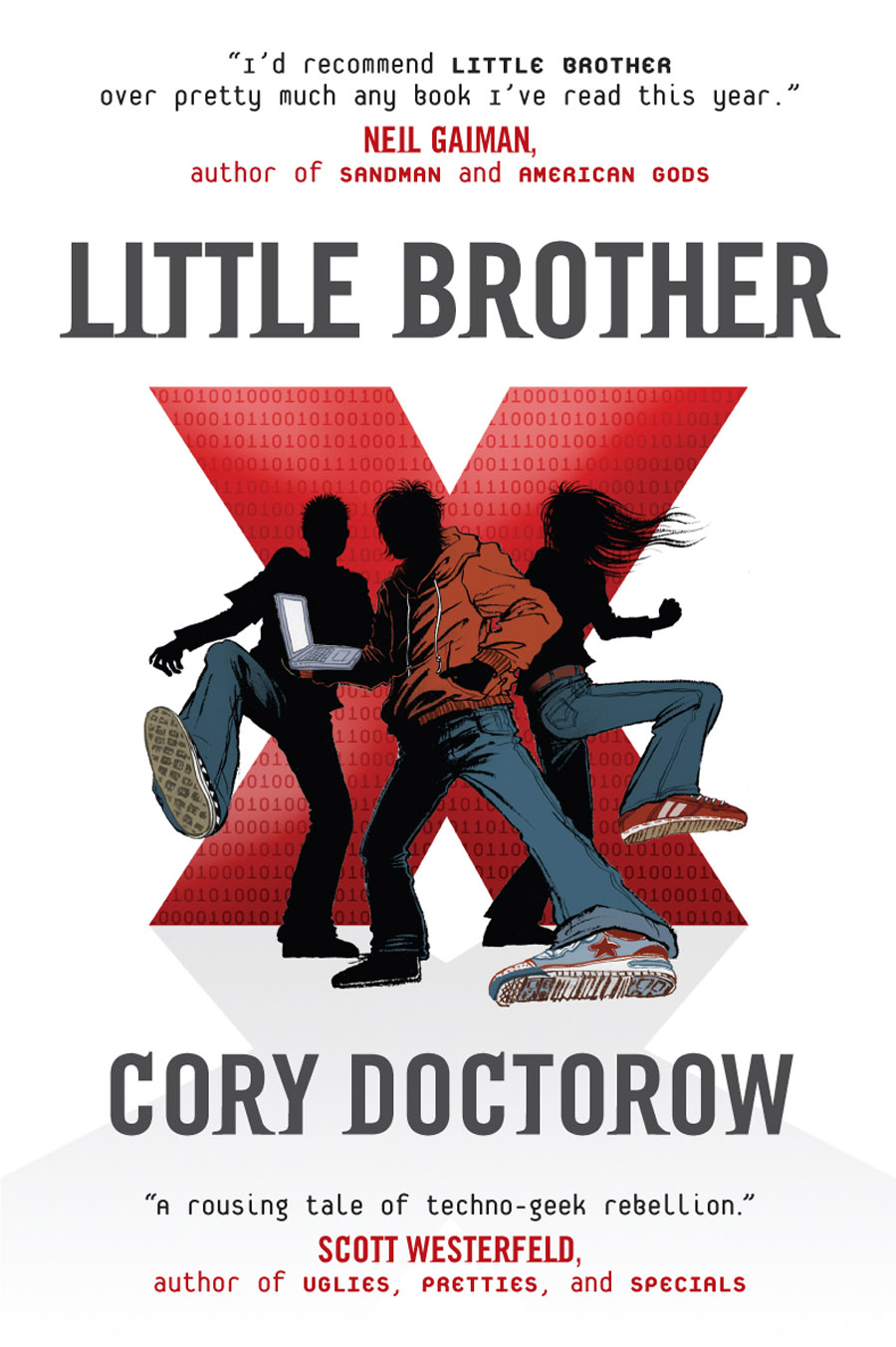
I just finished reading Cory Doctorow's Little Brother. I highly recommend it to those who like stories about technology and using technology in a clandestine manner. It reminded me a lot of a book I read a long time ago by Clifford Stoll called The Cuckoo's Egg. The books have different plots (in Stoll's book the hacker is the bad guy), but in both you get a small glimpse into the hacker culture.
Even if you don't like stories about technology, however, you should read Little Brother. It's an inspiring tale about a young man not willing to let the government get away with tyranny even if it means his own freedom.
One interesting aspect in my experience reading this book was following along with Google Maps Street View. I was able to follow the action in the streets of San Francisco (a city that I've been to twice but really didn't get to see). Try it, it's fun.
Obama on Iraq...for now
I guess I should have seen this coming. Oh wait, I did. So, for those of you who were worried that I might vote for Obama (if I was really, really forced to), don't worry.
Wednesday, July 02, 2008
Whatever
- All new technologies should have a Star Wars demo
- If this is a joke it sure the hell ain't funny (HT: Dispatches)
- Some sanity on 'cap-and-trade' schemes
- #51. They don't sit around reading lists about how to be successful
- Obama panders and panders and panders
- What can onions teach us about oil prices?
Wednesday, June 25, 2008
Whatever
- I love this idea of "competing" tax plans. It's like competition between McDonald's and Burger King - the differences are marginal and they both suck.
- Oooh, save me from Google, I'm so oppressed
- Jason Kuznicki does a great job at debunking the idea that the recent Supreme Court decision regarding Habeas rights will lead to a "flood" of lawsuits. And here is some good stuff from George Will, as well.
- The Web Time Forgot (annoying, free registration may be required - try BugMeNot)
- Is labeling menus with nutritional content a good idea? Maybe not.
Monday, June 23, 2008
Oh Obama!
I know I've blogged in the past that if forced to I would vote for Obama. But now it is becoming harder for me to even make that concession.
Obama has given his support to a bill that will, in Glenn Greenwald's words, legalize "many of the warrantless eavesdropping activities George Bush secretly and illegally ordered in 2001." Here is the way he justifies his decision:
Secondly, I thought I had a Constitution to protect my liberties, not your work ethic.
My very limited support for Obama was largely based on his rhetoric that he would get us out of Iraq. Now I'm thinking that if he is elected President we will get a statement from him next January which begins thusly,
Obama has given his support to a bill that will, in Glenn Greenwald's words, legalize "many of the warrantless eavesdropping activities George Bush secretly and illegally ordered in 2001." Here is the way he justifies his decision:
Given the grave threats that we face, our national security agencies must have the capability to gather intelligence and track down terrorists before they strike, while respecting the rule of law and the privacy and civil liberties of the American people. . . .First of all, what if you are not elected President? You just supported a bill that you basically admit has problems that could affect the liberty of the American people. How will you feel in January if John McCain gets that power? You shouldn't support legislation that has as a contingency the need for the "right" people enforcing said legislation.
After months of negotiation, the House today passed a compromise that, while far from perfect, is a marked improvement over last year's Protect America Act. . . It does, however, grant retroactive immunity, and I will work in the Senate to remove this provision so that we can seek full accountability for past offenses.
It is not all that I would want. But given the legitimate threats we face, providing effective intelligence collection tools with appropriate safeguards is too important to delay. So I support the compromise, but do so with a firm pledge that as President, I will carefully monitor the program, review the report by the Inspectors General, and work with the Congress to take any additional steps I deem necessary to protect the lives -– and the liberty –- of the American people.
Secondly, I thought I had a Constitution to protect my liberties, not your work ethic.
My very limited support for Obama was largely based on his rhetoric that he would get us out of Iraq. Now I'm thinking that if he is elected President we will get a statement from him next January which begins thusly,
Given the grave threats that we face, our military must continue to be deployed ... blah blah blah.Whatever!
Wednesday, June 18, 2008
Whatever
- Carbon Nanotubes seem to be the duct tape of science
- Now this is my kind of town
- Oil 2.0
- Time to break out the aerosol cans again
- Oh how cute. Cuba is joining the Twentieth Century.
- Yeah, you know you're curious
- This is just unfortunate
- I should keep my witty comments to myself on this one because my wife reads this blog (but I'd love one of these)
Tuesday, June 17, 2008
No Win
We are now going to have the courts flooded with so-called...habeas corpus suits against the government, whether it be about the diet, whether it be about the reading material. And we are going to be bollixed up in a way that is terribly unfortunate because we need to go ahead and adjudicate these cases."Those were the words of John McCain in response to the recent Supreme Court ruling on Guantanamo Bay detainees. It is also a big reason why I can't vote for him this year.
Habeas Corpus is not about filing suits to complain about diet or reading material; the term literally means 'you have the body'. It is a basic right, not of Americans, but of all human beings to challenge their imprisonment in front of a neutral party. For McCain, a Senator and Presidential candidate, to make such a silly statement is disturbing.
I shouldn't be surprised, though. I've always disliked McCain because of his stance on civil liberties. His support for
Oh, BTW, here is one of many reasons why I can't vote for Obama this year either. Surprise, surprise, he'll raise taxes.
Monday, June 16, 2008
Little Pink Houses
People of Cary unite! Rise up against those who would allow home values to not soar ever so skyward! Down with the powers who do nothing to free us from the pain we suffer when prospective buyers avert their eyes!
The Colorist class, with their disdain for the historical progress of drab, must no longer be allowed to offend the Beige class. Talk of 'rights' is a polycolorist tactic which should be looked upon with a blank stare, and disregarded as if not even mentioned.
Polycolorism, after all, is just a superstructure foisted upon society at the behest of the Colorists with the full complicity of their pawns in power. We must break the chains that bind us to this superstructure so that history can pass into the Age of Drabness.
Rise up! Or succumb to the Rainbow.
The Colorist class, with their disdain for the historical progress of drab, must no longer be allowed to offend the Beige class. Talk of 'rights' is a polycolorist tactic which should be looked upon with a blank stare, and disregarded as if not even mentioned.
Polycolorism, after all, is just a superstructure foisted upon society at the behest of the Colorists with the full complicity of their pawns in power. We must break the chains that bind us to this superstructure so that history can pass into the Age of Drabness.
Rise up! Or succumb to the Rainbow.
Wednesday, June 11, 2008
Whatever
- Surprise yourself!
- Markets adapt, government exacerbates (HT: EconLog). More of the same.
- i cn se whi she hat a sezur
- Gee, raising the minimum wage is hurting unskilled workers. Who'd thought that?
- Minesweeper, The Movie
- Man-made Global Shaking?
- Goosh!
Wednesday, June 04, 2008
Whatever
- Another reason why Wal-Mart is one of the greatest anti-poverty forces in history
- Neat stuff for space geeks (like me)
- This is utterly disgusting. Check out the sign - "Find out when you should die." (HT: Coyote Blog)
- I beg your pardon?
- The 100 Greatest Guitar Songs of All Time (Purple Rain!?! in the top 20)
- Can you really love your country? "Insisting on the alleged virtue of loving one’s country mainly serves to give those in power a blank check."
Monday, June 02, 2008
The Religion of Politics
[I recently finished Bryan Caplan's The Myth of the Rational Voter. In this and future posts I will provide my chapter-by-chapter notes.]
Beyond the Miracle of Aggregation
He asks the question: Are voter errors systematic on questions of direct political relevance? He answers yes, and lays out a set of biases that voters seem to hold. These are
Caplan then goes on to talk about how politics is a form of religion: "Political/economic ideology is the religion of modernity." People find comfort in politics as they do with religion, and some of the same passions are exhibited as well. He gives the comparison of the Inquisition of the Middle Ages and totalitarian regimes of the 20th Century. I've often made the comparison between socialism and religion. Caplan, however, does not make this comparison himself - it's nationalism and social revolutions that he is concerned with.
Keeping with the theme of religion, Caplan shows how voters can afford to be ideological. In a democracy voters do not pay the "full price" for their beliefs because the odds of one vote having a substantial influence on policy diminishes with the growing voter base. "The price of ideological loyalty is close to zero," so people can easily partake in ideological delusions. "Faith is a shortcut to belief."
In a democracy, "negative externalities irrelevant to individual behavior add up to a large collective misfortune." People will rationalize their errors, however, going so far as to deify those who encourage their delusions; victimizing those who destroy those delusions.
All this means is that in the end democracies fall short because voters get the foolish policies they ask for.
Beyond the Miracle of Aggregation
Voter ignorance is a product of natural human selfishness, not a transient cultural aberration.Caplan explains the Aggregation concept which says that individual voter ignorance is canceled out over the large population of voters. His main thesis, however, shows that this only applies if there isn't systematic ignorance throughout the population (or the voters don't make systematic errors).
- Bryan Caplan
He asks the question: Are voter errors systematic on questions of direct political relevance? He answers yes, and lays out a set of biases that voters seem to hold. These are
- Antimarket bias
- Antiforeign bias
- Make-work bias
- Pessimistic bias
Caplan then goes on to talk about how politics is a form of religion: "Political/economic ideology is the religion of modernity." People find comfort in politics as they do with religion, and some of the same passions are exhibited as well. He gives the comparison of the Inquisition of the Middle Ages and totalitarian regimes of the 20th Century. I've often made the comparison between socialism and religion. Caplan, however, does not make this comparison himself - it's nationalism and social revolutions that he is concerned with.
Keeping with the theme of religion, Caplan shows how voters can afford to be ideological. In a democracy voters do not pay the "full price" for their beliefs because the odds of one vote having a substantial influence on policy diminishes with the growing voter base. "The price of ideological loyalty is close to zero," so people can easily partake in ideological delusions. "Faith is a shortcut to belief."
In a democracy, "negative externalities irrelevant to individual behavior add up to a large collective misfortune." People will rationalize their errors, however, going so far as to deify those who encourage their delusions; victimizing those who destroy those delusions.
All this means is that in the end democracies fall short because voters get the foolish policies they ask for.
Wednesday, May 28, 2008
Whatever
- An interesting way to use a courier service
- Three small dots were never so impressive
- And I thought those people with Bluetooth phone headsets were annoying!
- Another reason why voting this year will be pointless. Neither candidate understands the the concept of individual liberty.
Wednesday, May 21, 2008
The Price of Eyeballs
On a recent episode of EconTalk, Russ Roberts interviewed Chris Anderson who was claiming "many delightful things in the world are increasingly free." This is supposed to be some new economics that businesses need to conform to or die. I'm skeptical.
The economics behind this phenomena is actually interesting, and Fernando Herrera-Gonzalez over at the Mises Institute I think explains it incredibly well. The following is where it clicked for me:
Now Microsoft is actually making this even more blatant. They plan on paying cash to users who purchase goods found using their Live Search engine.
The interesting thing is that is this is not new. Broadcast television has operated on this model for over fifty years - they pay for your eyeballs with entertainment so that they can attract their true customers.
The economics behind this phenomena is actually interesting, and Fernando Herrera-Gonzalez over at the Mises Institute I think explains it incredibly well. The following is where it clicked for me:
Google offers us free use of their search engine and other web applications. Why? Because that is how Google attracts our attention to its advertisements. Google doesn't sell its online services to us; it sells an audience to its actual costumers, the advertisers. Google is buying our time and selling it wholesale. As time is a scarce resource, and time (and attention) demand is increasing as a result of fierce competition on the Internet, Google has to pay us ever more, according to the law of diminishing returns. This payment is made not in terms of money, but as storage and process capacity. That's why Google keeps increasing its "free" offering to us, its providers, in terms of, e.g., storage capacity for e-mail accounts.You see, we are not Google's customers. Google pays us for our eyeballs with free disk space and applications so that they can attract their true customers - advertisers.
Now Microsoft is actually making this even more blatant. They plan on paying cash to users who purchase goods found using their Live Search engine.
The interesting thing is that is this is not new. Broadcast television has operated on this model for over fifty years - they pay for your eyeballs with entertainment so that they can attract their true customers.
Subscribe to:
Posts (Atom)